For Those Behind The Walls, Letters Are Our Lifelines

There is currently a proposal to dramatically restrict inmates in the Santa Clara County jail system from receiving letters. Steeda McGruder, founder of Sisters That Been There, writes about the profound power of receiving letters while incarcerated, and shares correspondence from women currently behind the walls who write about the “life-saving” value of letters. Click image to read pieces on Silicon Valley De-Bug

steedaletters
(Steeda shows the many letters she received from women in the system who reach out to get support. They say letters are there “lifelines.”)

ACJP Presents to Santa Clara County Juvenile Attorneys

Last week the Albert Cobarrubias Justice squad presented to the attorneys of the juvenile division of the Santa Clara County Public Defender’s Office. We were invited to share our experiences, perspectives, and our model of how families can play a role in partnering with defense attorneys to protect youth from the system. It was a very productive sit down as we brought some of our leading organizers who first got introduced to the system through witnessing their own children face the courts. Their is nothing more insightful than a mother’s observations. We also shared the video, made by Cesar Flores, that was used by a defense attorney earlier this year to further her point that her client was being over-charged. The young man was able to resolve his case without jail or prison time, as well as preserving his relief for immigration court. We look forward to continuing our partnering efforts to keep youth out of the system!

acjppd

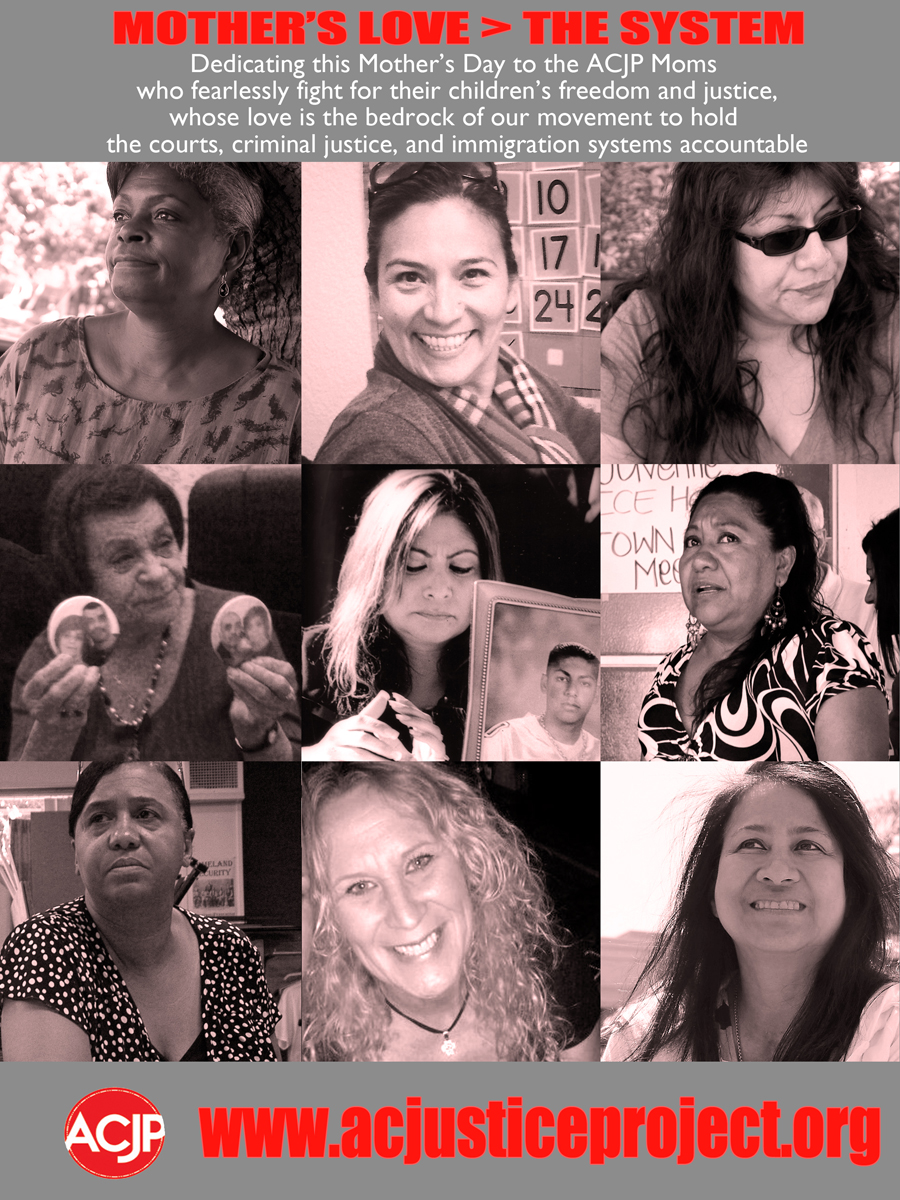
Mother’s Day Math: Mother’s Love > The System

We couldn’t fit all the ACJP mothers in one picture, but here are a few of them whose strength fuels us all to keep going, to keep fighting.  They come every Sunday or Tuesday — after their visits with their children in jail, or even way after their children’s court cases are over — to then uplift other family members who have faced the same struggles.  Happy Mothers’ Day to these Moms!  Submission Post by Charisse Domingo
acjpmomma

Mini-Doc: Transforming the Courts Through Family and Community Participation

As we launch our training series for organizations to impact their local court system, we are releasing this mini-documentary to give a glimpse into the stories, strategies, and triumphs we have witnessed. From a mother freeing her son, to a church creating an ACJP hub, this video shows the early stages of our growth (recorded a year and a half ago.) Feel free to share as we are now offering trainings to groups or regions on how to start this practice in their communities. Check it out, and contact us if you want to discuss trainings!

Time Saved: 3 Families Support Each Other to Beat a Collective of 41 Years to Life in Prison

Image

We had a powerful meeting this Sunday at ACJP, where three families all successfully resolved their cases through mutual support. They didn’t know each other a month ago, but will be forever united in their life stories. They live in different counties, even speak different languages at home.These images are a part of ACJP‘s “Time Saved” Series, documenting the stories, and amount of time saved from incarceration, due to community intervention in court cases. Submission and Photos by Charisse Domingo.

Click here to see the full story.  

ACJP in East San Jose Celebrates Two Years of Re-Uniting Families, Beating False Arrests, and Stopping Deportations

beckyCongratulations to Becky Cardenas and the rest of the ACJP team on their two year anniversary of ACJP at East Valley Pentecostal Church! Every Tuesday, rain or shine, the ACJP squad has met with families who have come to those evening meetings seeking assistance for themselves and their loved ones. The ACJP team have partnering with them to better understand the court system (both criminal and immigration court), identify what role they can play as a supportive family, and ultimately change the outcome of countless cases. The gatherings have allowed families to know that they are not alone, can get supported by the community, and can bring their loved ones home. Families have learned how to better connect with the appointed lawyer, and ensure that their loved one is receiving the zealous defense they deserve. We’ve had a countless number of families come through our Tuesday ACJP sessions, but here were some examples that show a glimpse as to the transformative power of family and community organizing. And if you are so moved, we would love if you “like” the blog page,  “follow” the blog to stay updated, and share the work with those who may be interested.

ACJP at EVPC In Action:

1) Families Can Transform the Courts: Mom Attends First ACJP When Son is Detained, Son Attends First ACJP When He is Released

2) Charges Dropped After Illegal Search

3) Three Strikes Sentencing Looses.Family Wins.Father Home to Raise Baby Girl

4) Son’s Advocacy Steers Court Away from 2 Year Prison Sentence for Mother

5) San Jose Mercury News: Some living in Santee neighborhood allege security guards roughing up residents

Continue reading

Jeff Adachi’s Public Defender Justice Summit

ACJP/De-Bug Crew with our friend Rap, founder of Gideon's Promis

ACJP/De-Bug Crew with our friend Rap, founder of Gideon’s Promis

Last week, ACJP organizers drove up to San Francisco for the 10th Annual Public Defender Justice Summit. The summit coincided with the 50th Anniversary of the Gideon ruling, and as such lent itself to very timely and inspiring discussions. The panels of discussants were pioneering attorneys, film producers, authors, and other stakeholders of the criminal justice system who are invested in bringing more fairness to the courts. The event was organized by Jeff Adachi, the elected San Francisco Public Defender. Continue reading

Gideon’s 50th Anniversary: Agreement on the Problem of Unfair Representation, But What About Solutions?

By Raj Jayadev
This month marks the 50th anniversary of one of the most significant Supreme Court decisions this country’s criminal justice system has ever known – Gideon V. Wainwright. The case, along with later decisions, cemented the 6th amendment right to counsel for anyone, regardless if they have the ability to pay.

But in a quick scan of the media today of monthly magazines to news dailies on the topic, readers will find one unified reflection expressed — half a century after Gideon, we are far from realizing effective representation for all. A sweep of the titles reads like a punch in the gut: “Right to Lawyer Eludes the Poor” (New York Times), “Indigent Clients Suffer as Public Defenders Struggle to Keep Up with Caseloads” (Washington Post), “Serious Problems Persist in Indigent Legal Defense” (Associated Press). There are films and books being released to coincide with the anniversary, which give a fuller and more intimate look into the grinding machinery of a broken court system. And while the unanimity on identifying the problem, even echoed from the US Attorney General to the leading legal scholars of our time, is striking, what stands out the most is what is missing from the discussion – solutions.

What can we do so we are not reading the same dismal headlines on the 60th anniversary of Gideon vs. Wainwright? Continue reading

In the Isolation of Immigration Court, A Son Finds His Mother


cesar2Immigration court in San Francisco has two branches — one for those in custody, and ones for those who have been released.  For those in custody, they remain shackled, are dressed in ICE jail clothes of green and soft orange shoes, and cannot have any contact with family or friends who are there to support them.  Even when their case is up for deliberation, they remain in chains.

Usually, the courtrooms for the detained are deserts. It is the detainee, sometimes with their attorney, against the prosecutor and the judge.  But yesterday, for this young man’s court, 16 people filled the courtroom.  He had his fierce attorney by his side.  And in the seats — family, clergy of various faiths, De-Bug, a San Mateo County District Attorney and a Private Defender who had helped see him through his case, sat to bear witness, to support, and to send a message that there is a community of people who want this young man home.

This is a picture of him and his mother holding each other for a brief moment, after nearly 8 months in ICE custody. This young man is now in his 30’s, but in this moment of embrace, he is the loved child, holding his mother tight in a difficult time. – Photo and Submission Post by Charisse Domingo

Why Public Defender Offices Should Have Public Information Officers

ACJPCourtThe month marks the 50th anniversary of one of the most significant Supreme Court decisions this country’s criminal justice system has ever known – Gideon V. Wainwright. The case, along with later decisions, cemented the 6th amendment right to counsel for anyone, regardless if they have the ability to pay for an attorney or not. To protect this right, we now have indigent defense systems (such as Public Defender’s Offices and Private Defender Panels) in counties and states, which serve the eighty percent of people who face criminal charges.

Chances are the only people who are going to recognize this date – both to honor the historic victory and acknowledge how far our indigent defense systems have to go to fulfill the promise of Gideon – will be lawyers. But the condition of indigent defense systems in 2013 is not a discussion only for attorneys. That’s like saying the need to solve a medical issue that affects 80 percent of everyone who enters a hospital should only be had amongst the doctors. Continue reading