The New York Times — Why Police Lie Under Oath

03POLICE-popupMichelle Alexander describing what we see at ACJP fairly regularly, and explaining the context as to why it happens.

Why Police Lie Under Oath

Published: February 2, 2013

By: Michelle Alexander, the author of “The New Jim Crow: Mass Incarceration in the Age of Colorblindness.”

THOUSANDS of people plead guilty to crimes every year in the United States because they know that the odds of a jury’s believing their word over a police officer’s are slim to none. As a juror, whom are you likely to believe: the alleged criminal in an orange jumpsuit or two well-groomed police officers in uniforms who just swore to God they’re telling the truth, the whole truth and nothing but? As one of my colleagues recently put it, “Everyone knows you have to be crazy to accuse the police of lying.”

But are police officers necessarily more trustworthy than alleged criminals? I think not. Not just because the police have a special inclination toward confabulation, but because, disturbingly, they have an incentive to lie. In this era of mass incarceration, the police shouldn’t be trusted any more than any other witness, perhaps less so. Continue reading

Mercury News: Dave Cortese, Molly O’Neal and Cynthia Hunter: Santa Clara County should keep current immigration policy


cubanologyOPEDBelow is an op-ed authored by a powerful collective of civic leaders in Santa Clara County that just appeared in the Mercury News.  We thank Supervisor Dave Cortese, Public Defender Molly O’Neal and Executive Director of the Domestic Violence Advocacy Consortium Cynthia Hunter for courageously standing up to protect our policy.

We are asking folks to please share and add your support through online comments. Please know that when it comes to immigration issues, those who want to change the policy will be likely very active on the comment box. One approach is to accept that, and pay it no mind, but if you would like to engage on behalf of the beliefs espouse by the op-ed, please do. We have to let our leaders know they are supported by the public when they champion our positions. Thank you!

You can also email the Board of Supervisors to let them know to keep Santa Clara County’s Immigrant Detainer policy as is!

Mike Wasserman    mike.wasserman@bos.sccgov.org
George Shirakawa    supervisor.shirakawa@bos.sccgov.org
Dave Cortese    dave.cortese@bos.sccgov.org
Ken Yeager    supervisor.yeager@bos.sccgov.org
Joe Simitian    supervisor.simitian@bos.sccgov.org


Dave Cortese, Molly O’Neal and Cynthia Hunter: Santa Clara County should keep current immigration policy
<http://www.mercurynews.com/opinion/ci_22474917/dave-cortese-molly-oneal-and-cynthia-hunter-santa>
There is nothing more valuable to public safety than community trust in local law enforcement because it establishes residents’ willingness to report crimes and to cooperate with police. But that trust will break down immeasurably in immigrant communities if residents face the debilitating fear of potential deportation. Continue reading

Harnessing the Power of Community Through Mitigation Packets: How Letters Beat a Juvenile Hall Sentence

photo[1]A San Mateo family came to ACJP about 3 months ago after their attorney had heard us present to the Juvenile Private Defenders in San Mateo County on our work on mitigation.  It was after their 17 year old son had taken a plea in Santa Clara County but then was transferred to San Mateo County to decide on his disposition. This is usually the case for juveniles who allegedly commit a crime in one county but do not live in that county.  In this case, the crime took place in Palo Alto but they live in Redwood City.

They were told at an initial meeting by a probation officer in San Mateo County that he was recommending 30 days in-custody time for the young man. Not only could this be harsh for him, but it would expose him to potentially devastating immigration consequences.  His attorney had been impressed by the number of people who showed up to his first hearing in San Mateo, and she wanted ACJP to help in capturing that community support in order to help convince the judge for a different disposition.

In a short amount of time, we gathered letters from different mentors in this young man’s life — adults who had always seen him as intelligent, gentle, and carried leadership potential.  These words describing him were in many of those letters. Many of them said they didn’t know what to say, but it turned out they just didn’t know how to begin.  So we would say, “Just write about him — write your observations, how long you’ve known him, and what kind of support you think you can give him.”  In came a flood of letters — compassionate, heartfelt.  One woman who went to church with him and the family wrote, “I would ask the court to show him mercy, not because he doesn’t need to see the consequences of his actions, but because I don’t believe he’s too far gone to be helped and supported to make better decisions. That light is still in him. When I see him now, he’s still the same kid who’ll make an extra batch of French fries when company’s over; who’ll show up early or stay late to vacuum, decorate a room or load cars after church events. I know there’s a lot of good in that mind and heart of his and a very bright future ahead, if he can be made to see that.”

When this young man’s hearing came on Friday, the attorney prepared him and his family for the worst.  To the 12 family and community members who showed up in support, she said that she would still plead for an out of custody placement, especially pointing to the large community support that was willing to step up for him.  By the time she had met with the District Attorney and Probation Officer, she was beaming with excitement.  They had agreed to offer him a program that not only would be out of custody, but would remove his felony plea as soon as he completes a year of good behavior.  It was something even the attorney didn’t anticipate.  The letters — especially the one from his parents — made the difference.

As a result, this young man is home, and he can continue on with pursuing his dreams in life — of going to culinary school, fixing his immigration matters.  Being able to harness the power of community in a “packet” helps decisionmakers see the young person in front of them as more than just their case file.  We believe the justice system is ultimately colored by our own human eyes and sentiment, and being able to show the fullness of someone’s life and community not only changes the outcome of a case, but transforms the system as a whole. — Submission Post by Charisse Domingo

Home for The Holidays: ACJP Family Beats 35 Year Sentence for Crime He Didn’t Commit

gabe
He faced 35 years in prison for a crime he didn’t commit. He needed life saving surgery while in jail. She fought for his freedom and his medical needs. As a result he got his surgery, and got out within months — no prison, and was released three days before his daughter’s birthday. Happy holidays, and may all loved ones separated due to injustice be together soon.

Keeping Families Together — Using Photographs to Show Why Loved Ones Should Not Be Deported

cpThis week, we at ACJP worked with a family and their attorney to put together an almost 100 page mitigation packet to help support their loved one’s deportation proceedings and hopefully convince immigration officials to let their brother stay in the US.  Their brother and his siblings were victims of a horrific crime, one that has traumatized him and his family for years. 

One of the parts of the packet is a photo album of the family with their brother. Sifting through hundreds of photographs that their mother and sister very diligently kept, one photograph stood out.  This is a photo of the Christmas tree that they put up every year, and one of the most special ornaments is a picture of their brother with the family. He has spent nearly 9 Christmases away from them, struggling to fight his case.  They put the picture up as a loving message to him that he is with them, and hopefully soon enough –he will come home.

There’s Something About Mary’s Family: Bringing Loved Ones Home After Three Strikes Reform

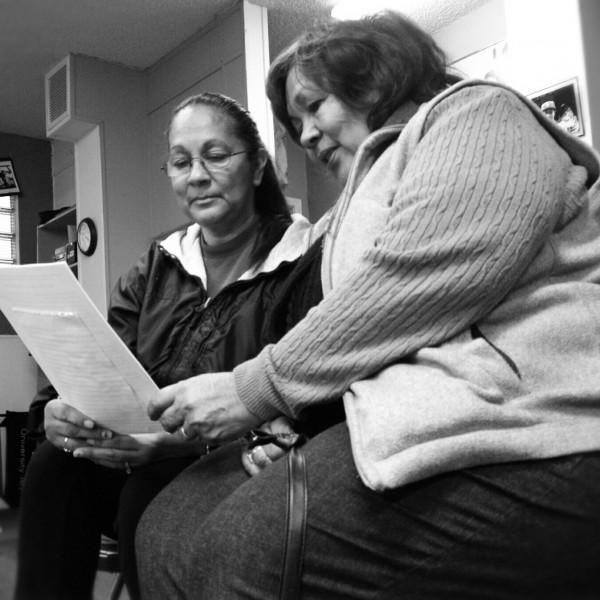
Mary (left) and her mother review paperwork to bring her brother home.

(Post by Raj Jayadev)

Mary came to the first Sunday ACJP meeting after the election with a new look in her eye, and sat with a calm yet ready presence of revitalized hope. Mary’s brother has been in the state prison system for nearly 20 years for a non-violent crime due to the Three Strikes Law. Prior to the passage of Proposition 36, Mary had been attending De-Bug’s ACJP meetings, regularly working with other families to try to find a pathway to bring him home. They explored the appellate process, poured over all of his paperwork, and called attorneys from numerous counties to find some avenue of relief. The odds seemed stacked against them, but Mary and her family maintained a hope in something that transcended the limits of probability, and turned a deaf ear on those who said to just give up.

A few months ago, one of ACJP’s lead facilitators, Blanca, started to talk to Mary about a proposition that was going to be on the ballot that could be the vehicle she had been praying for. That proposition, Proposition 36, would allow California voters to amend the Three Strikes Law so that the third offense would have to be a serious violent crime for it to result in a life sentence. And the change would work retroactively, meaning those who had been serving a life sentence due to Three Strikes would be able to get re-sentenced without the limited imposition of a life sentence. In short, some families, like Mary’s, who had been told they would only be able to see their loved ones in prison visits, would be able to bring them home. Continue reading

San Jose Mercury News: California Prop. 36: Families of some three-strikers hope for early release or shorter sentences

On Tuesday, November 6th, California voters approved Prop 36, a ballot measure that would reform the Three Strikes Law of 1994. An estimated 3,000 convicted felons serving life sentences for a third strike that was a non-violent crime could now apply to the courts for resentencing. ACJP families are elated at the news knowing that some of their family members could qualify.  Lily, whose son Darryl has been serving a life sentence, is ecstatic, and said her son had been anxious about these elections.  He had received a letter notifying him that he was eligible for the Prop 36 reforms. In many ways, California has been the trendsetter in the nation when it comes to excessive sentencing.  We hope the passage of Prop 36 signals another trend — away from these extremely harsh laws and more humane criminal justice policies. — Submission Post by Charisse Domingo

California Prop. 36: Families of some three-strikers hope for early release or shorter sentences

By Tracey Kaplan
tkaplan@mercurynews.com

SAN JOSE — Cashier Debbie Curry woke up Wednesday to find California voters had given her a priceless gift: hope.

By an overwhelming margin, they’d passed Proposition 36 to revise the state’s tough Three Strikes Law.

The new law prohibits judges from imposing a life sentence on most repeat offenders who commit minor crimes. But it also includes a provision that could result in an early release or shorter sentence for Curry’s husband — and up to 3,000 inmates like him who were sentenced to life in prison for nonviolent, relatively minor crimes like stealing a credit card.
Continue reading

ACJP Presents on Mitigation to the San Mateo County Juvenile Private Defenders Program

Two weeks ago, De-Bug’s ACJP presented to the San Mateo County Juvenile Private Defender’s Program on our work in supporting families develop mitigation packets.  This presentation was part of a longer session on San Mateo County Probation’s ICE referral policy for youth.  Coordinated by Adam Wells Ely, a juvenile private defender who has been active in local efforts to stop this referral practice, De-Bug co-presented with Helen Beasley from Community Legal Services in East Palo Alto and Alison Kamhi from the Stanford Law School’s Immigrants’ Rights Clinic. A key part of the change advocated by the San Mateo County Coalition for Immigrant Rights to the Probation Chief’s policy on referring youth to immigration was that before a probation officer was to make a referral to ICE, the juvenile private defender and the youth’s family were to be notified so they could present mitigating information that can help the PO to decide otherwise.  Thus, being able to gather that information by the team of people supporting their loved one can be key to helping stop an ICE referral.

De-Bug’s ACJP shared different examples of mitigation packets we developed that resulted in families being able to change the outcome of their loved ones’ cases — from a packet of letters, to photo diaries, to a mini-documentary video that helps the court system see the full life of the person behind the case file.  Thanks to San Mateo County’s Private Defender’s Program for acknowledging the role and value of community in advocating for loved ones in the courts! 

PHOTO ESSAY: Sisters That Been There Celebration of Life Ceremony

Congrats to Steeda, founder of Sisters That Been There, and the recent class of graduates! Followers of this blog know Steeda — the incredible leader from the De-Bug fam who created an innovative re-entry program for recently released women in Santa Clara County. Santa Clara County Probation was so impressed with Steeda, they supported the program through by integrated the project into their realignment plan. Much achieved, and much to come! Click on the image to see images from the graduation and read more about her work!

New York Times Editorial: Who Will Mourn George Whitmore, Jr?

In 1968, George Whitmore, Jr. was beaten by New York police and coerced to signing a 61 page confession that he murdered two women.  He contended that he was somewhere else that day — watching Martin Luther King Jr’s historic civil rights speech and had witnesses who could attest to him.  Nevertheless, he was convicted for these murders.  Steadfast to his innocence — and supported by lawyers, advocates, and civil rights activists — his conviction was overturned 9 years later.  And his case was pivotal to the Supreme Court’s Miranda ruling to protect alleged suspects and to the partial repeal of capital punishment in New York City. 

While he is 3,000 miles away from Santa Clara County, the impact of his resolve to maintain his innocence reverbrates here.  At ACJP, we’ve seen youth as young as 15 forced to make confessions to crimes they didn’t commit.  But because of cases like Mr. Whitmore Jr, people can still be protected.  This particular editorial talks about the emotional toll the system can take on you and the personal fall-out of the struggle for justice.  It is this silent and sad struggle that is rarely documented.  To the question the writer posed on “Who Will Mourn George Whitmore Jr”, we resoundingly answer — we will, and we will honor his sacrifice as we hold our systems accountable.  Submitted by Charisse Domingo

Op-Ed Contributor
Who Will Mourn George Whitmore?
By T. J. ENGLISH
Photo by Tom Cunningham/NY Daily News, via Getty Images
New York Times
Published: October 12, 2012

I received news this week of the death of George Whitmore Jr., an occurrence noted, apparently, by no one in the public arena. That Whitmore could die without a single mention in the media is a commentary on a city and nation that would rather bury and forget the difficult aspects of our shared history.

Forty-eight years ago, as a New York City teenager, Whitmore was initiated into an ordeal at the hands of a racist criminal justice system. For a time, his story rattled the news cycle. He was chewed up and spit out: an ill-prepared kid vilified as a murderer, then championed as an emblem of injustice and, finally, cast aside. That he survived his tribulations and lived to the age of 68 was a miracle.
Continue reading